
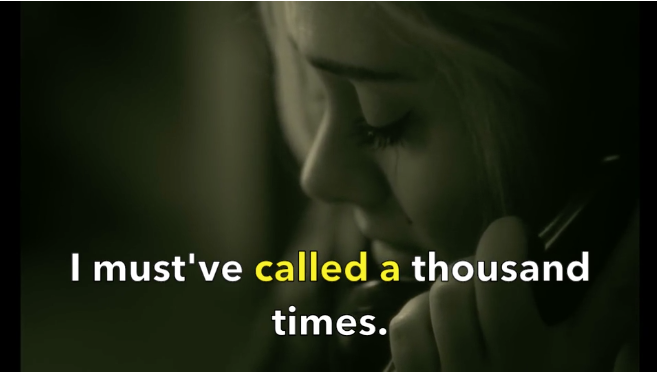
As you know, the “-ed” endings of regular past tense verbs can be pronounced in three different ways: /t/, /d/, and /ɪd/, which is the one most students tend to overuse. Click here for an overview of the rules.
Over the years, I have found that /t/ and /d/ are easier to notice and to produce if the verb comes immediately before a word beginning with a vowel sound:
liked it – /laɪktɪt/
dreamed of – /driːmdəv/
To help students get their tongues around the two sounds, I usually ask them to move /t/ and /d/ to the front of the vowel sound. This makes it obvious that there’s no room for /ɪ/:
liked it – /laɪk tɪt/
dreamed of – /driːm dəv/
Out of all the ideas and techniques I’ve used in class, this has probably been the most effective.
So I decided to put together a 7-minute video containing 12 song excerpts you can use to help your students notice how /t/ and /d/ are linked to the vowel sounds that follow. They are old songs, but I hope the activity will still appeal to students.
The video is suitable for late A2, B1, B2, and even C1 students, who will have learned the basic -ED rules but may still struggle to produce the sounds accurately. The on-screen activities are all self-explanatory.
You will notice that the activities do not test whether students can choose between /t/ and /d/. The difference is barely audible in fast connected speech, and it rarely causes misunderstandings. Also, since most students tend to overuse /ɪd/ and avoid /t/ or /d/, the song excerpts focus on the latter rather than the former.
By the way, if the video is out of synch, go back to the beginning and/or refresh the page.
Thanks for reading – and watching.
Just loved the video!!
I’ll use it with all my groups!! Thanks a million!!!😉
Thanks, Ani! Let me know how it works!
Wow. …it’s just perfect. Thanks a zillion👏👏👏👏👏
Thanks loved the videos
Nice! The video really useful.
It’s a raining day in Vix, so it was good enough, but now it’s even better cause I’ll be listening to music while teaching all day….P.S: U know lyrics.training.com? Thanks a bunch!
Thanks, Elizabeth. Gonna check out the site.
*rainy ☺
tks for sharing such a great material , in fact I use with beginners too. I’ve missed the /id/.
Thanks a million for sharing this material. I will use them with my students in a couple of weeks when I have to teach past simple. I bet it will work well, especially because I have used phonemic transcription with them in class.
Thanks, Márcio! Any feedback is most welcome.
Excellent post, thank you. I will be sharing this with all of my students.
Thank you!
Thanks so much for sharing this video, Luiz! 🙂 In face-to-face lessons, my secondary learners are struggling with ‘ED’ pronunciation. I will try to use this video to help them improve their pronunciation, and I believe they will love it. 🙂
This is great. I’m going to try it with my low intermediate adults. We’ll see who sings!
Ann, maybe half of them? Well, they can always repeat the sentences without necessarily singing.
This is fabulous, Luiz! It must have taken ages to compile. My young adults will love it =) Thank you so much.
About two days, Gillian! Thanks for stopping by.
Million thanks 😍
🙂
Great video and examples! I´m gonna share this with my students.
Thank you! Let me know how it goes.
Сооl job!
🙂
Can’t open the video…why?
No one’s complained yet. Don’t know what could be wrong.
Loved it!
🙂
This is brilliant. My teenagers will love this. Thank you so much.
Let me know how it works!
I am so grateful to you as well as to that huge and big efforts you make for teaching and learning English
My pleasure, Kamal!
many thanks from Latvia
🙂
This is just perfect, thankssssssssssssssssssss
🙂
Absolutely brilliant. Can’t wait to use this on class next week. Thank you.
Let me know how it goes!
Pls provide details so that I can be added to your mailing list.
Hi Sasha! Just like my FB page – that’s the easiest way! https://www.facebook.com/thinkELT/
Hi Luiz! It’s been a while since the last time I was here, don’t know why.Your work always amazes me!
Talking about this particular activity, I absolutely loved your technique of asking students to move /t/ and /d/ to the front of the vowel sound, brilliant! I’ll be using it soon.
A funny thought crossed my mind while I watched the video, your mind must race every time you hear a song, thinking about all the sounds and how you can use that to teach, can you enjoy the music itself? Just kidding 🙂
Thanks a bunch!
Hi Luisa, yes, you’re right. Hard to enjoy music / sitcoms / movies to the fullest – I’m always looking for things I could use as teaching material. Thank you for your kind words.
What a terrific way to teach this! Thank you.
Thank you!
This is fantastic! I’m going to type up and print out the examples of the verbs with the word after it and have my students first predict and put them in two columns that that think have the “t” or “d” ending sound. We’ll see how it works.
Great! Let me know how it works, Rachel!
great vid… will be using it in my classes!
Let me know how it works!
What an awesome activity, Luiz! Fun and effective. I really like how it also practices other sounds and helps students with connected speech. Thanks a lot for your generosity in sharing it!
My pleasure, Carina! Glad it worked well.
Fantastic effort, a teacher who goes the extra mile! Or extra 50 miles! Well done.
Hi Luiz,
Just to let you know that we’ve shortlisted this blog post for this month’s TeachingEnglish blog award and I’ll be putting up a post about it on today’s TeachingEnglish Facebook page http://www.facebook.com/TeachingEnglish.BritishCouncil, if you’d like to check there for comments.
Best,
Ann
What an honour, Ann! Thank you!
This is absolutely fantastic….i love it…my students will love it….thank you so much!
Thank you!
Brilliant, as usual. Fun and effective. Thank you for sharing!
Thank you!
Thank you very much for your hard work! I’ll try it out!
Let me know how it works!
This lesson plan is fantastic…I think it will be very useful with our students. Thanks a lot
Thank you! Let me know how it works!
Olá Luiz Otavio
Como posso comprar o seu livro? Tenho interesse na habilidade de escrever bem e gostaria do livro 600 examples of academic language.
Esse livro ajuda quem quer aprender a escrever para web bem assim para o leitor comum ou é apenas para teses de faculdade?
Só clicar na capa, amigo! Ou seguir este link:
https://www.amazon.com/Only-Academic-Phrasebook-Youll-Ever-ebook/dp/B01M0QFVHL/ref=sr_1_1?ie=UTF8&qid=1474664030&sr=8-1&keywords=luiz+otavio
O livro é direcionado, sim, para trabalhos acadêmicos de faculdade. Mas talvez você ache útil.
Na Amazon, existe a possibilidade de você olhar as primeiras páginas.
Luiz Otávio, tks 4 sharing such a great and useful masterpiece. I’ve already sent it to some friends and will use w/ some students. Gr8 job, dear.
Thank you so much, sincerely, for putting together such a useful, well thought-out video.
When students are taught grammar rules only, they miss out on such richer worlds.
Like in this case, where correct pronunciation and linking sounds make a mere tense alive.
Ops, I messed up with the website field…
Thanks SO much for sharing this – it’s amazing!! Really generous of you to share what couldn’t have been easy to create.
Esse livro ajuda quem quer aprender a escrever para web bem assim para o leitor comum ou é apenas para teses de faculdade?
This video is wondelful!!! My students were singing and easily understood the use /t/ and /d/ at the end of regular verbs. Thank you so much!!!
Elena, glad you found it useful!
Actually there are five ways to pronounce ed in the past tense. That said I love your passion for teaching and will be using your video 😀
Bernard, mainstream ELT lists 3 ways. I wonder what the other 2 are.
Brilliant! Thanks for sharing.
Thank you so much, sincerely! Carol me Ensina
You’re the best!
Great and very useful video!
Thank you sooooo much for sharing this lesson 🙂
You’re welcome!
Luis, this is great! Thank you for sharing. Do you have any other ways that you use songs in your classes? I recently watched Paul Seligson’s IATEFL Chile talk on using songs in the classroom on youtube. I think that you might enjoy it, lots of great ideas. Oh yes, what do you use to cut/edit the videos to the short exerpts ? :0)
Great choice of songs, and there are several chances for students to practice, thanks to the fine editing. As for the tongue twister in 12, that may be due to the way native speakers tend to drop ‘t’s before ‘w’s (as in that we). My students love your video lessons and they are usually not very easily impressed, so thank you and please keep sharing.
Thank you for your kind words!
thanks for that! super useful 🙂
Thank you!
This is a great resource. Be careful, however, with the phonetic transcriptions. For example, “locked out” in the American and Canadian dialects will change the /t/ to a /d/. It’s the same with “walked out.”
Hi Julie,
/k/ is a voiceless sound, so, theoretically, at least, the /t/ should sound like /t/, shouldn’t it?
Do you have any references to back this up?
actually there are five ways to pronounce ed in the past tense. That said I love your passion for teaching and will be using your video
Just loved the video!!
I’ll use it with all my groups!! Thanks a million!!!😉
Thank you!
This is simply incredible! THANK YOU, thank you, thank you! I can’t thank you enough.
Thank you!