
Academic writing · Word choice
Hedging Exercises for Academic Writing
Good academic writing doesn’t claim more than the evidence shows. Practice softening your claims with words like arguably, seem, and tend to, and learn when a fact needs no hedge at all. Every answer comes with an explanation.
- Hedging: Soften claims your evidence can’t fully support: proves → suggests, always → often, will → is likely to.
- Arguably: Use it for debatable opinions, never for facts. It could be argued that … works the same way.
- Extent: Use to: to some extent, to what extent, the extent to which. But the extent of + noun.
- Seem: seem + adjective or to + verb; seem to have + past participle for the past; there seem to be + plural noun. Don’t use it for facts.
- Tend to: For typical patterns, not facts. The noun is tendency.
- Avoiding overgeneralization: on the whole, by and large, in most cases, as a rule, generally speaking, more often than not.
These points are covered in full in Lessons 15A–15F of The Academic Writing Lifesaver — Compact Edition.
Choose the best word or phrase.
Choose the option that best completes each sentence.
1The results of this small pilot study ? that the new drug reduces anxiety.
Answer: suggest. A small pilot study gives early evidence, not final proof. Suggest claims only what the data can support.
The other option
proveToo bold. One small study can’t prove that a drug works. Use suggest.
2? what extent do online reviews influence consumer choices?
Answer: To. To what extent means how much or how far.
The other options
InExtent takes to: to what extent, to some extent.
AtThe fixed phrase is to what extent, not at.
3The school-meal program, which ran from 2010 to 2015, ? attendance in poorer districts.
Answer: seems to have raised. Seem to have + past participle hedges a claim about the past.
The other option
seems to raiseThe program ended in 2015, so you’re speculating about the past. Use seem to have + past participle.
4There ? to be several reasons for the drop in membership.
Answer: seem. There seem to be + plural noun (several reasons). With a singular noun, use there seems to be.
The other option
seemsThe verb agrees with the noun that follows. Reasons is plural, so use seem.
5Remote work is ? the biggest change to office life since the arrival of email.
Answer: arguably. The biggest change is an opinion others might dispute, so arguably is a good fit.
The other options
proven to beToo bold. The biggest change is a judgment, and judgments can’t always be proven.
arguableThis is the adjective. Before the biggest change, you need the adverb arguably.
6Students who sleep less than six hours a night ? lower grades.
Answer: tend to get. Tend to describes a typical pattern without claiming it’s true in every case.
The other options
always getToo bold. Some students who sleep very little still do well.
tend gettingTend is followed by to + verb: tend to get.
7?, the new timetable has reduced overcrowding, although some routes are still busy.
Answer: On the whole. On the whole means generally, so it softens the claim about the timetable.
The other options
In the wholeThe fixed phrase is on the whole.
On a wholeThis mixes up on the whole and as a whole. Use on the whole.
8More often ? not, a first draft is longer than it needs to be.
Answer: than. More often than not means usually, so it shows that the claim isn’t true of every draft.
The other option
thenThen is about time or sequence. The fixed phrase is more often than not.
9Respondents, by and ?, were satisfied with the new service.
Answer: large. By and large means mostly or generally, so it shows that not every respondent was satisfied.
The other options
bigThe fixed phrase is by and large.
farYou may be thinking of by far (= by a great amount). Here you need by and large.
10Novice researchers show a strong ? to rely on a single source.
Answer: tendency. Tendency is the noun form of tend. Show a tendency to is another way to hedge.
The other options
tendTend is a verb. After a strong, you need the noun tendency.
tendenceThis form isn’t used in modern English. The noun is tendency.
Mistake or correct?
Decide whether each sentence hedges correctly. Watch for claims that are too bold, hedges used with facts, and words in the wrong form. Six have a mistake and four are correct.
1Historians still disagree about the extent which the treaty caused the war.
The extent to which means how much. Don’t drop to: the extent to which the treaty caused the war.
2The new rules are likely to reduce traffic in the city center.
Are likely to hedges a prediction. Compare the bolder will reduce, which claims certainty.
3All participants in the study tend to be over 65.
This is a fact about your sample, not a general pattern, and all contradicts tend to. Drop the hedge: All participants in the study were over 65.
4On paper, the two proposals seem similarly, but their budgets differ sharply.
After seem, use an adjective, not an adverb: On paper, the two proposals seem similar …
5It could be argued that tourism has done more harm than good to the island’s culture.
It could be argued that presents a strong opinion while admitting that others may disagree.
6A single experiment with 30 mice proves that the drug will cure the disease in humans.
Too bold. One animal study can’t prove what will happen in humans. Hedge it: … suggests that the drug may help treat the disease in humans.
7The new policy appears to have had little effect on hiring.
Appear works like seem. Appears to have had hedges a claim about the past.
8To a large extent, the project’s success depended on local volunteers.
To a large extent means mostly, but not entirely. Note the preposition to.
9In most of cases, the symptoms disappear within a week.
The phrase is in most cases: In most cases, the symptoms … (Most of needs the: in most of the cases we studied.)
10The survey arguably included 300 respondents.
The number of respondents is a fact, not an opinion, so there’s nothing to argue about: The survey included 300 respondents.
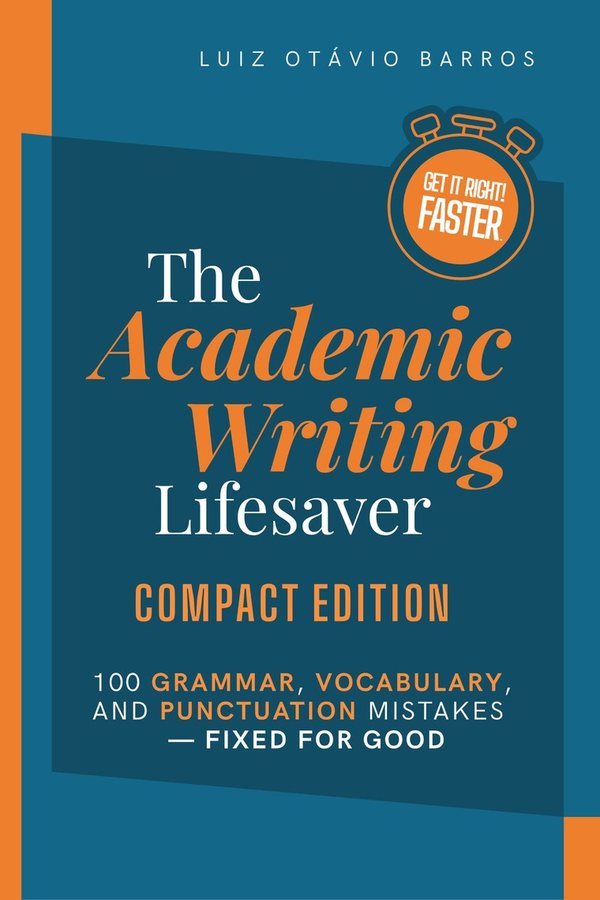
Go deeper: Lessons 15A–15F
Hedging is covered in full in Lessons 15A–15F of The Academic Writing Lifesaver — Compact Edition, with more examples, extra hedging expressions, and self-check exercises.