
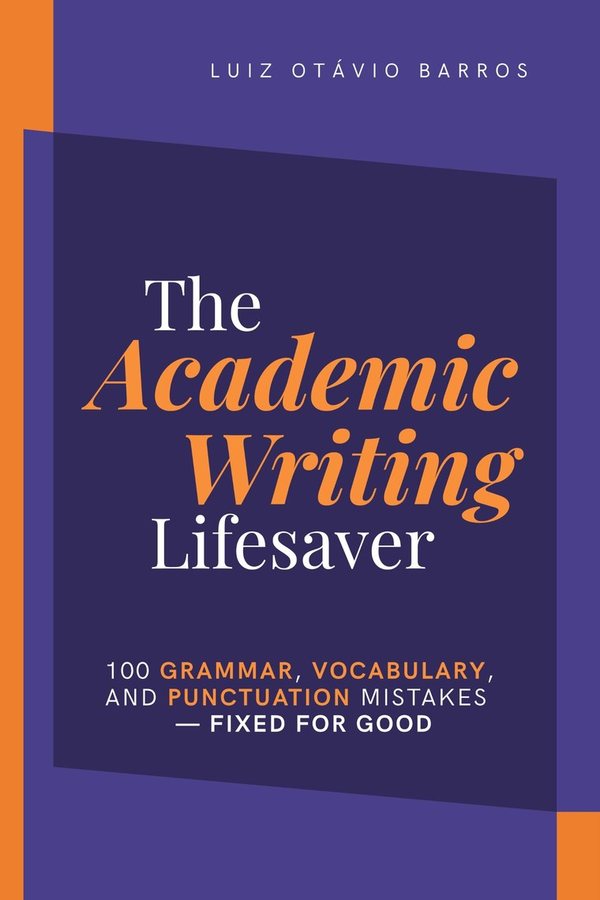
The Academic Writing Lifesaver
100 grammar, vocabulary, and punctuation mistakes, fixed for good
By Luiz Otávio Barros
If you keep second-guessing your grammar, mixing up similar words, or wondering where the comma goes, this book is for you. Each of its 100 short lessons takes one mistake that students often make in essays, papers, and theses, and shows you how to fix it.
- 100 short, self-contained lessons
- 16 sections from confused words to hedging
- Self-check exercise in every lesson, with answers
Every lesson starts with a real mistake
Each lesson opens with a sentence that is wrong, or acceptable but not ideal for academic writing, next to its corrected version. These six are from the book.
- Affect or effect?Stress can
effectaffect your performance on an exam. - Assure, ensure, or insure?We
assuredensured that all participants met the screening criteria. - Comprise, consist, or compose?The USA
comprises ofcomprises 50 states and Washington, D.C. - Everyday or every day?Most respondents said they listened to rap music
everydayevery day. - Each of them is or are?There are five questions, and each of them
areis worth two points. - Neither or none?He applied to two universities, but
noneneither accepted his application.
How a lesson works
All 100 lessons follow the same clear format, so you always know where to look.
- Common issueThe mistake and its corrected version, side by side.
- EssentialsA plain explanation of why the mistake happens and how to avoid it, with academic examples.
- Learning hackA quick trick or memory aid to make the point stick, in many of the lessons.
- Self-checkA short exercise, with the answers at the bottom of the page and at the end of the book.
16 sections, from commas to hedging
Each section deals with one area of the language used in academic writing. You can work through the sections in any order.
- Commonly confused words
- Singular or plural?
- Subject-verb agreement
- Comma use
- Apostrophes and hyphens
- Referring back to earlier ideas
- Contrast and concession
- Similarities and differences
- Making causal relationships clear
- Adding information
- Clarifying, specifying, and illustrating
- Everyday vs. academic English
- Conciseness, clarity, and flow
- Hedging
- Native-speaker mistakes
Plus an A–Z index, a guide to grammar terms, and a full answer key with comments on the tricky points.
Who it’s for
- College students who are native speakers of English
- International students and advanced learners of English (C1/C2)
- TOEFL and IELTS candidates who want to improve their writing
- English teachers taking the DELTA or Trinity Diploma
What this book is (and isn’t)
This is not a comprehensive usage and style guide. It leaves out the grammar debates and pet peeves that won’t affect your academic work, and concentrates on the mistakes students make most often.
It is designed for self-study. The lessons are short and self-contained, with as little jargon as possible.
What readers say
“… the entries focus precisely on the areas we struggle with the most, the explanations are crystal clear, and the examples are thoughtfully selected.”
Amazon reader
“If writing with accuracy is what you are looking for, this book is for you.”
Amazon reader
Read 13 lessons free
The free sample has the contents pages, “This book in a nutshell”, and Sections 1 and 4 in full: 13 of the book’s 100 lessons. Flip through it in your browser, or have the PDF sent to your inbox.
Open the free sample Email me the PDF
No email app on this device? Write to requestforsamples@gmail.com with “Lifesaver sample” in the subject line.
Book details
- Full title: The Academic Writing Lifesaver: 100 Grammar, Vocabulary, and Punctuation Mistakes, Fixed for Good
- Author: Luiz Otávio Barros
- Series: Academic English Unlocked
- Contents: 100 lessons in 16 sections, each with a self-check, plus an A–Z index, a guide to grammar terms, and a full answer key
- Length: 168 pages (paperback)
- Formats: paperback and ebook
- First published: 2025
- Paperback ISBN: 978-6598652593
Questions readers ask
Is it for native speakers or for learners of English?
Both. It is written for native-speaker college students, international students, and advanced learners at C1 and C2 level.
Is it a complete grammar or style guide?
No. It covers 100 mistakes that come up again and again in essays, papers, and theses, and leaves out grammar debates and pet peeves that don’t affect academic work.
Can I use it on my own?
Yes. The lessons are short and self-contained, and each one ends with a self-check. The answers are at the bottom of the page and at the end of the book.
How is it different from the Compact Edition?
This edition has longer explanations, more examples, and practice after every lesson. The Compact Edition puts the core into 100 one-page lessons for quick reference. Compare the three academic books.
Write without second-guessing your English
Available in paperback and ebook.
Not sure this is the one you need? Compare my three academic books.