
Academic writing · Grammar
Dangling Modifiers, Wordiness, and Parallel Structure: Exercises
Clear academic writing says more with fewer words. Practice cutting redundant words, fixing dangling modifiers, and keeping your lists parallel. Every answer comes with an explanation.
- Unnecessary words: Cut words that repeat an idea: final conclusion → conclusion, future plans → plans, in the process of revising → revising.
- Shorter phrases and clauses: the report that was published → the report published; the policy on data sharing → the data-sharing policy.
- Dangling modifiers (1): Make sure the introductory phrase logically describes the subject that follows: After reading the report, we changed the design.
- Dangling modifiers (2): Passive sentences often cause them. Switch to the active voice and name who acted: To test the idea, we ran a pilot study.
- Nominalization: Noun phrases (conduct an investigation into) sound formal, but too many make writing wordy. Use the verb (investigate) when the noun adds nothing.
- Parallel structure: Keep listed items in the same form: to plan, draft, and revise.
These points are covered in full in Lessons 14A–14F of The Academic Writing Lifesaver — Compact Edition.
Choose the best option.
Choose one of the options. The question under each sentence tells you what to look for.
1Many first-year students struggle with statistics because they never learned the ? of algebra.
Which option is more concise?
Answer: fundamentals. One word does the job: the fundamentals of algebra.
The other option
basic fundamentalsFundamentals are basic by definition, so basic adds nothing.
2In 2019, the two research units ? to form a single institute.
Which option is more concise?
Answer: combined. Combine already means put together, so it needs no help.
The other option
combined togetherTogether repeats the meaning of combined. Cut it.
3The questionnaire ? to all staff members included twelve items.
Which option is grammatically correct and the most concise?
Answer: sent. The past participle replaces the whole clause that was sent.
The other options
sendingAn -ing form gives an active meaning, as if the questionnaire sent something. It was sent, so use sent.
that was sentGrammatical, but wordy. Cut that was: The questionnaire sent to all staff members …
4? that regular exercise improves sleep quality.
Which option is more concise?
Answer: Several studies show. Make studies the subject and show the verb. It’s shorter and more direct.
The other option
There are several studies showingThis is grammatical, but Several studies show … presents the evidence more directly and uses fewer words.
5Having interviewed all forty participants, ?.
Which option is grammatically correct?
Answer: the researchers began coding the transcripts. The researchers did the interviewing, so they come right after the comma.
The other options
the transcripts were coded by the researchersNow the transcripts seem to have interviewed the participants. Put the people who did it right after the comma.
the coding of the transcripts beganThe coding didn’t interview anyone. Name who did: the researchers.
6The research assistants ? the survey data over the summer.
Which option is more concise?
Answer: analyzed. The verb analyze says the same thing more directly.
The other option
carried out an analysis ofFive words where one verb does the job. Here the noun phrase only makes the sentence longer.
7This chapter explains ? the reform failed in rural areas.
Which option is more concise?
Answer: why. Explains why expresses the intended meaning more concisely.
The other option
the reason whyThis is grammatical, but the reason can be omitted here: This chapter explains why the reform failed …
8After cleaning the dataset, ?.
Which option is grammatically correct?
Answer: we ran a t-test on the scores. We cleaned the dataset, so we comes right after the comma.
The other option
a t-test was run on the scoresNobody is named, so the opening phrase has no logical subject. Say who cleaned the data: we ran a t-test …
9The new program aims to cut waiting times, improve patient care, and ? staff turnover.
Which option is grammatically correct?
Answer: reduce. Three verbs in the same form: cut, improve, and reduce.
The other options
reducingThe list has cut and improve, so the third item must match: reduce, not reducing.
a reduction inA noun phrase breaks the pattern of verbs (cut, improve, …). Use reduce.
10Surprisingly, ? in the journal’s history was written by two graduate students.
Which option is more concise?
Answer: the most-downloaded paper. This expresses the same idea in fewer words. The most downloaded paper, without a hyphen, is also acceptable.
The other option
the paper with the most downloadsThe prepositional phrase can be turned into a shorter noun modifier: the most-downloaded paper.
Mistake or correct?
Decide whether each sentence is correct. Look for dangling modifiers, broken parallel structure, and missing hyphens. Six have a mistake and four are correct.
1As a first-year student, the library seemed overwhelming to me.
The library wasn’t a first-year student; I was. Put the right subject after the comma: As a first-year student, I found the library overwhelming.
2Participants were asked to rate the app, describe its weaknesses, and suggesting improvements.
The list starts with rate and describe, so the last item must match: … and suggest improvements.
3Careful consideration was given to the ethical risks of the study.
Nominalization isn’t a mistake. Here, careful consideration gives the sentence a formal, impersonal tone without making it difficult to follow.
4The authors make a well documented case for stricter regulation.
Use a hyphen in a well-documented case, but normally leave this combination open after the noun: The case is well documented. Combinations with an -ly adverb stay open: a thoroughly documented case.
5To reduce bias, the researchers presented the questions in random order.
The researchers presented the questions in random order to reduce bias, so the opening phrase clearly connects to the subject.
6The intervention raised attendance, reduced dropout rates, and improved test scores.
Three past-tense verbs, each followed by its object: raised …, reduced …, and improved …. That’s parallel structure.
7Uncertain how to classify the responses, the analysis was postponed.
The researchers were uncertain, not the analysis. Name them as the subject: Uncertain how to classify the responses, we postponed the analysis.
8Having spent decades in public health, her views carry considerable weight.
Her views didn’t spend decades in public health; she did. Make her the subject: Having spent decades in public health, she brings considerable authority to the debate.
9The committee reached a decision after two hours of debate.
Reach a decision is a natural verb–noun combination that fits this sentence. The committee decided after two hours of debate would also work.
10The proposal was criticized not only by teachers but also parents rejected it.
After not only … but also, both parts need the same form. Here a passive phrase (criticized by teachers) is paired with an active clause (parents rejected it). Make both passive: The proposal was not only criticized by teachers but also rejected by parents.
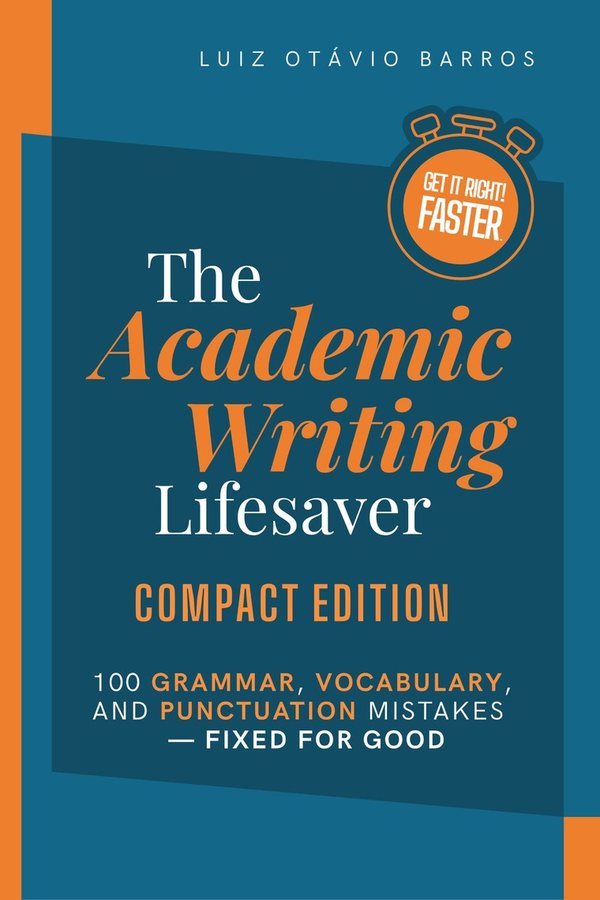
Go deeper: Lessons 14A–14F
Concise, clear sentences are covered in full in Lessons 14A–14F of The Academic Writing Lifesaver — Compact Edition, with more examples, watch-out notes, and self-check exercises.