
Academic writing · Punctuation
Apostrophe and Hyphen Exercises for Academic Writing
A misplaced apostrophe or a missing hyphen is easy to overlook and hard for a reader to ignore. Practice the cases that catch out even careful writers, native speakers included. Every answer comes with an explanation.
- Plural vs. possessive: Plurals take no apostrophe: results, not result’s. Possessives: the author’s ideas (one), the authors’ ideas (more than one), the children’s ideas. For singular names ending in s, this page follows Chicago style: Ross’s. Some styles use Ross’.
- It’s or its: It’s = it is or it has. Its is possessive, like their.
- Who’s or whose: Who’s = who is or who has. Whose is possessive.
- There, they’re, or their: There = a place, or there is/are. They’re = they are. Their is possessive.
- Hyphens (1): Many compound adjectives are hyphenated before a noun: a well-known author. After the noun, some lose the hyphen (the author is well known); others keep it (the method is time-consuming).
- Hyphens (2): Hyphenate ex- (= former) and most self- compounds: ex-president, self-taught. Hyphenate high- and low- compounds before a noun (a low-budget film), and fractions and numbers from twenty-one to ninety-nine written as words (three-quarters, forty-five). With a number + unit before a noun, add a hyphen and keep the unit singular: a three-year study. No hyphen after an -ly adverb: a widely used test.
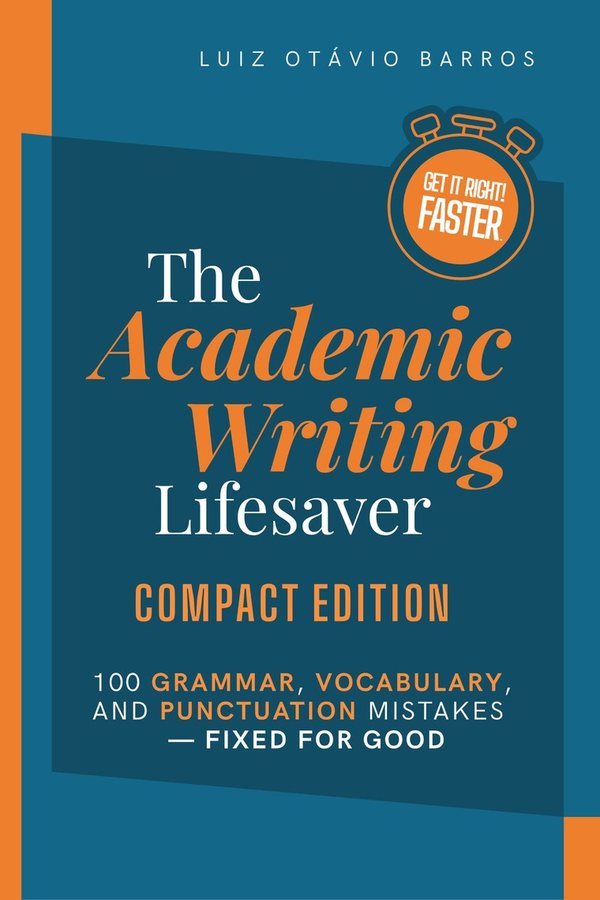
These points are covered in full in Lessons 6A–6F of The Academic Writing Lifesaver — Compact Edition.
Choose the correct form.
Choose the form that best completes each sentence.
1Most ? now offer online degree programs.
Answer: universities. This is a simple plural, so no apostrophe: university → universities.
The other options
universities’The apostrophe shows possession, but nothing belongs to the universities here.
university’sAdding ‘s never makes a word plural. Most needs a plural noun.
2The ? drawings were displayed in the school hallway.
Answer: children’s. Children is a plural that doesn’t end in s, so it takes ‘s, like people’s and women’s.
The other options
childrens’Children is already plural. There’s no word childrens.
childrensThere’s no word childrens, and the drawings belong to the children, so you need an apostrophe.
3Employees are entitled to four ? vacation a year.
Answer: weeks’. A plural ending in s takes just an apostrophe: four weeks’ vacation, like a year’s delay.
The other options
week’sFour weeks is plural, so the apostrophe goes after the s.
weeksTime expressions like this take a possessive apostrophe: four weeks’ vacation.
4The university has updated ? policy on the use of AI tools.
Answer: its. The policy belongs to the university, so use the possessive its, like their.
The other option
it’sTry it is: updated it is policy makes no sense.
5Experts warn that ? becoming harder to find qualified nurses.
Answer: it’s. You can say it is becoming harder, so use it’s.
The other option
itsIts is possessive, but nothing belongs to anything here. You need it is.
6The prize went to an architect ? designs use only local materials.
Answer: whose. The designs belong to the architect, so use the possessive whose.
The other option
who’sTry who is or who has: an architect who is designs use … makes no sense.
7We need someone ? familiar with qualitative methods.
Answer: who’s. You can say someone who is familiar, so use who’s.
The other option
whoseWhose shows possession and needs a noun after it (whose work).
8If the results hold up, ? likely to change how the disease is treated.
Answer: they’re. You can say they are likely, so use they’re.
The other options
theirTheir is possessive and needs a noun after it (their results).
thereThere refers to a place or starts there is/are.
9The laboratory installed ? sensors to detect tiny changes in pressure.
Answer: high-precision. High-precision works as one adjective describing the sensors.
The other option
high precisionUse a hyphen in this compound before sensors: high-precision sensors.
10The crew set off on a ? voyage.
Answer: twenty-one-day. Hyphenate both twenty-one and the full modifier twenty-one-day; keep day singular.
The other options
twenty one-dayThe number twenty-one needs its own hyphen.
twenty-one-daysA unit used in this modifier stays singular: a twenty-one-day voyage.
Mistake or correct?
Decide whether each sentence uses apostrophes and hyphens correctly. Six have a mistake and four are correct.
1Professor Ramos’s seminar has been moved to Thursday.
A singular noun ending in s takes ‘s, as The Chicago Manual of Style recommends: Ramos’s. You’ll also see Ramos’ in some styles.
2Both authors’s arguments rest on the same assumption.
Authors is a plural ending in s, so add just an apostrophe: Both authors’ arguments …
3Many families struggle to pay there energy bills in winter.
Ask whose bills? The families’ bills, so you need the possessive: their energy bills.
4The patients’ records were kept up to date throughout the trial.
Patients’ is a plural possessive (the records of the patients). Up to date comes after the noun it describes, so it needs no hyphens. Compare up-to-date records.
5The museum will close it’s doors for a year of repairs.
Try it is: close it is doors makes no sense. The doors belong to the museum, so use its doors.
6The program offers a highly-structured approach to language learning.
Don’t hyphenate an adverb ending in -ly and the word after it: a highly structured approach.
7My supervisor is the only person who’s seen the full dataset.
Who’s is short for who has here: the only person who has seen the full dataset.
8Self employed workers often lack access to paid sick leave.
Most compounds beginning with self- take a hyphen: Self-employed workers …
9There were too few responses to draw firm conclusions.
There + be says that something exists: There were too few responses. Don’t confuse it with their (possessive) or they’re (they are).
10This approach may save money in the long-term.
Long term is a noun here, not an adjective before a noun, so no hyphen: in the long term. Compare a long-term solution.
Go deeper: Lessons 6A–6F
Apostrophes and hyphens are covered in full in Lessons 6A–6F of The Academic Writing Lifesaver — Compact Edition, with more examples, learning hacks, and self-check exercises.