
Academic writing · Grammar
E.g. vs. I.e., Such As, and Namely: Academic Writing Exercises
Small words like e.g., such as, and namely tell your reader how an example or detail relates to your point. Choose the wrong one, and the meaning changes. Practice the differences here. Every answer comes with an explanation.
- E.g. or i.e.: E.g. (= for example) introduces examples, not the full list. I.e. (= in other words) defines or clarifies what you just said. In American English, put a comma after both.
- For example: Between two sentences, the pattern is semicolon or period + for example + comma: Prices rose; for example, rents doubled. At the end of a sentence, a comma is enough: Rents doubled, for example.
- Like or such as: Use like for comparisons (= similar to / in the same way as). Both like and such as can introduce examples; such as is usually preferred in academic writing. Use commas when the examples are extra information; omit them when the examples identify the group you mean.
- In that, in the sense that: These explain in what way the first part is true: The plan is risky in that it depends on one supplier.
- Namely or including: Namely identifies exactly what you mean. Including introduces items within a group and usually suggests that the list is incomplete.
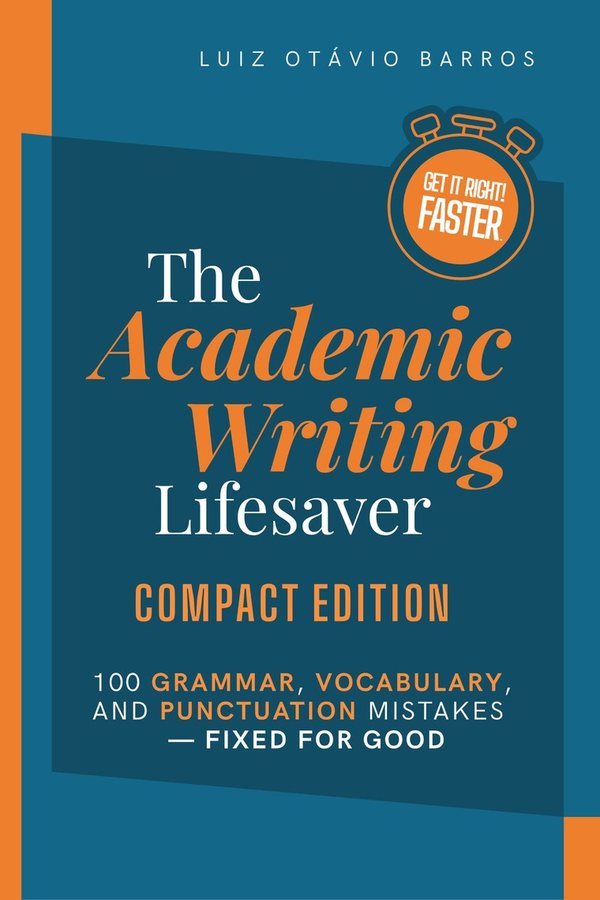
These points are covered in full in Lessons 12A–12E of The Academic Writing Lifesaver — Compact Edition.
Choose the correct word or phrase.
Choose the option that best completes each sentence.
1Participants were asked about their screen time, ? the hours they spent on phones, tablets, and computers each day.
Answer: i.e.,. The words after the gap define screen time. Use i.e. (= in other words) to define or clarify.
The other option
e.g.,E.g. introduces examples. Here, the words that follow explain what screen time means, so use i.e.
2Several Asian capitals (? Seoul and Bangkok) have invested heavily in public transportation.
Answer: e.g.,. Seoul and Bangkok are examples of such capitals, and there are others.
The other option
i.e.,I.e. would mean that Seoul and Bangkok are the only capitals meant. But two capitals aren’t several, so they must be examples.
3Not every metal is hard? sodium can be cut with a knife.
Answer: …hard; for example, sodium… These are two full sentences, so use a semicolon or period before for example and a comma after it.
The other option
…hard, for example, sodium…A comma can’t join two full sentences, even with for example. This is a comma splice.
4Bus services have improved a great deal. The last bus now runs at midnight?
Answer: …midnight, for example.. At the end of a sentence, for example follows a comma.
The other option
…midnight; for example.A semicolon must be followed by a full sentence. At the end, use a comma: … at midnight, for example.
5In some ways, the immune system works ? an army, with scouts, soldiers, and memory cells.
Answer: like. This is a comparison (= in the same way as), and only like can make comparisons.
The other option
such asSuch as introduces examples. Here, the immune system is being compared to an army, so use works like.
6Several string instruments, ? the cello and the harp, are played sitting down.
Answer: such as. Such as introduces examples. The commas show they’re extra information: remove them, and the basic meaning stays the same.
The other options
as suchAs such means in that role or therefore. It can’t introduce examples.
i.e.,I.e. introduces a definition or the exact items meant. Several string instruments suggests more than two, so these are examples.
7The comparison is unfair ? the two groups were tested under different conditions.
Answer: in that. In that explains in what way the comparison is unfair. Ask “In what way?” The answer: the two groups were tested under different conditions.
The other options
in order thatIn order that introduces a purpose. Here, the different conditions explain why the comparison is unfair. Use in that.
in whichIn which needs a noun to refer back to, as in the study in which … After unfair, there’s no noun.
8The book is difficult ? it assumes a lot of background knowledge.
Answer: in the sense that. The second part explains in what way the book is difficult: it assumes a lot of background knowledge.
The other option
in the sense whichThe expression is in the sense that, not in the sense which.
9The study had one major limitation, ? its small sample size.
Answer: namely. Namely gives the exact item you’ve just mentioned: the one major limitation is the small sample size.
The other option
includingIncluding usually introduces a selection from a larger set. Namely is clearer here because it identifies the one major limitation just mentioned.
10The festival attracts artists from many countries, ? Japan, Mexico, and Ghana.
Answer: including. Many countries is a larger set, and these three are examples from it.
The other option
namelyNamely introduces the complete list. Three countries aren’t many countries, so these must be examples.
Mistake or correct?
Decide whether each sentence is correct. Six have a mistake and four are correct.
1Deserts are not always hot, for example, much of Antarctica is a desert.
A comma can’t join two full sentences, even with for example. Use a semicolon or a period: … not always hot; for example, much of Antarctica …
2Many common household products (e.g., bleach and oven cleaner) can irritate the skin.
Bleach and oven cleaner are examples, and there are many others, so e.g. is right. Note the comma after it.
3Many everyday materials, such as glass and aluminum can be recycled again and again.
The examples are extra information, so they need a comma on both sides: Many everyday materials, such as glass and aluminum*,** can be recycled again and again.*
4The archive holds more than 5,000 letters, namely several written by the poet’s sister.
A few letters aren’t the complete list of 5,000, so namely doesn’t fit. Use including: … more than 5,000 letters, including several written by the poet’s sister.
5The museum is unusual in the sense that visitors can touch most of the exhibits.
Ask “In what way is it unusual?” The second part answers the question: visitors can touch most of the exhibits.
6The survey was conducted in Canada’s two official languages (e.g., English and French).
Canada has exactly two official languages, so these aren’t examples. They’re the complete set. Use i.e.: (i.e., English and French).
7Several team sports, for example rugby and hockey, have high injury rates.
Here for example introduces a list in the middle of a sentence. The pair of commas around the whole phrase is all it needs.
8The city’s canals work such as a giant drainage system during heavy rain.
This is a comparison, and only like can make comparisons: The city’s canals work like a giant drainage system …
9The committee interviewed several experts, including two economists and a historian.
Including picks out some of the experts interviewed. It doesn’t claim that the list is complete.
10The app is user-friendly in that over a million people have downloaded it.
Ask “In what way is it user-friendly?” Downloads show that the app is popular, not that it’s easy to use. Explain the quality itself: … user-friendly in that it requires no training.
Go deeper: Lessons 12A–12E
Clarifying, specifying, and illustrating are covered in full in Lessons 12A–12E of The Academic Writing Lifesaver — Compact Edition, with more examples, learning hacks, and self-check exercises.