
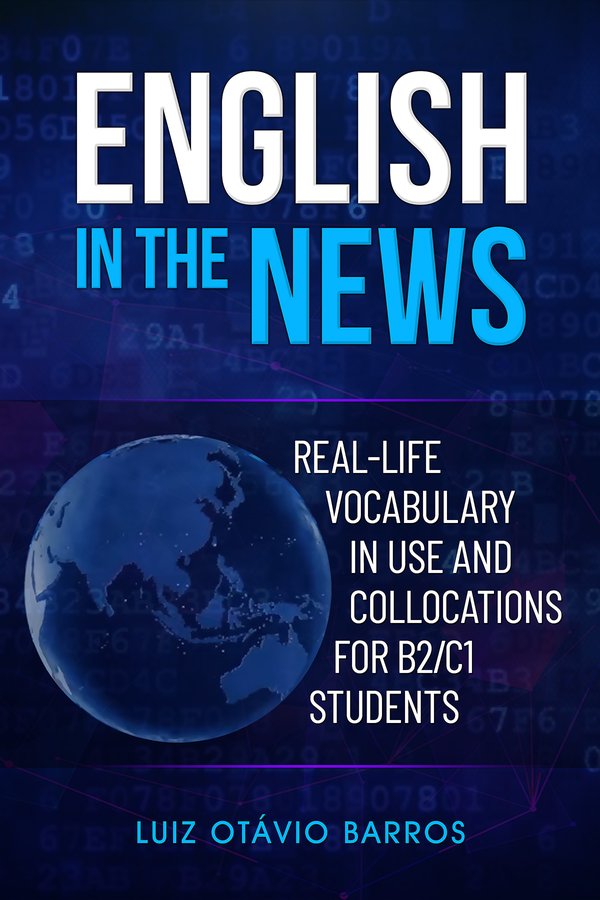
English in the News
Real-life vocabulary in use and collocations for B2/C1 students
By Luiz Otávio Barros
The news has a vocabulary of its own: words like backlash, bailout, and crackdown, which general coursebooks often ignore. This book teaches you 80 of them through headlines, each one rewritten in everyday English, so you can understand news reports much more easily.
- 80 words and expressions, one lesson each
- 13 quick checks with answers on the same page
- 19 billion words in the news corpus behind the collocations
Every lesson starts with a headline
Each lesson opens with a headline containing the target word, followed by the same headline in plain English. These six are from the book. All the names in the examples are made up.
- AftermathGreece: Flood aftermath triggers new concerns.= The situation following the floods in Greece has led to new worries.
- AimElton Tusk’s new chatbot aims to take on ChatCPP.= Elton Tusk’s new chatbot plans to compete with ChatCPP.
- AllegedChef in alleged poisoning case charged with murder.= A chef suspected of poisoning customers is now facing accusations of murder.
- All-timeCalifornia birth rate drops to all-time low in 2023.= Fewer babies were born in California in 2023 than in any other time in history.
- AmidAmid recession, parents tell kids ‘Santa isn’t coming.’= The economy is in a recession, so parents are telling their children they won’t be getting any Christmas gifts.
- AttemptIrish woman on solo attempt to reach South Pole.= An Irish woman is trying to reach the South Pole on her own.
How a lesson works
Each word gets a one-page lesson, divided into five or six short parts.
- The headlineA news headline containing the target word.
- In plain EnglishThe same headline rewritten in everyday English.
- DefinitionA simple definition of that particular use of the word.
- Pronunciation tipA short note to help you say the word correctly.
- Other examplesMore headlines, each one rewritten in simple English.
- Learn moreMore information on the word, its top collocations, or both.
80 words you’ll meet in the headlines
The lessons are in alphabetical order, with a quick check after every six or seven. Here are some of the words and expressions the book covers.
- aftermath
- alleged
- amid
- backlash
- bailout
- bipartisan
- breach
- breakthrough
- crackdown
- curb
- debacle
- deem
- feud
- footage
- grim
- hike
- landslide
- loom
- outbreak
- pledge
- probe
- slump
- surge
- unveil
- vow
- in the wake of
Plus a guide to headline grammar, a list of common news abbreviations, and a free audio recording of each lesson, which readers can request by email.
Who it’s for
- Upper-intermediate (B2) and advanced (C1) students of English as an additional language
- Candidates preparing for B2 First, C1 Advanced, TOEFL, TOEIC, MET, and IELTS
- Learners who want to follow the news in English with more confidence
What this book is (and isn’t)
This is a reference book for self-study, not a coursebook. Use it as a mini dictionary when a word comes up in your reading, or do one lesson at a time.
The examples are adapted from real sources, so the language feels authentic, but there are no references to real companies, products, celebrities, or politicians.
What readers say
“You will find a wide range of collocations, fixed phrases and isolated words that are meaningful to advanced students to learn, simply because it is the kind of language (everyday language) that students will encounter in the news.”
Amazon reader
“Understanding news in English can be quite challenging even for upper-intermediate and advanced speakers of English. In comes this really useful book with carefully curated vocabulary entries and clear explanations and examples of how each word is used.”
Amazon reader
Read 6 lessons free
The free sample has the contents pages, “This book in a nutshell”, lessons 1 to 6, and the first quick check: 6 of the book’s 80 lessons. Flip through it in your browser, or have the PDF sent to your inbox.
Open the free sample Email me the PDF
No email app on this device? Write to requestforsamples@gmail.com with “English in the News sample” in the subject line.
Book details
- Full title: English in the News: Real-Life Vocabulary in Use and Collocations for B2/C1 Students
- Author: Luiz Otávio Barros
- Level: B2 to C1
- Contents: 80 one-page lessons in alphabetical order, with 13 quick checks and answers, a headline grammar guide, and a list of common news abbreviations
- Length: 106 pages (paperback)
- Formats: paperback and Kindle
- First published: 2024
- Paperback ISBN: 978-6500895971
Questions readers ask
What level is it for?
Upper-intermediate (B2) and advanced (C1) learners of English, including candidates for B2 First, C1 Advanced, TOEFL, TOEIC, MET, and IELTS.
How do I use it?
It is a self-study reference book, not a coursebook. Use it as a mini dictionary when a word comes up in your reading, or work through one lesson at a time.
Is there audio?
Yes. A free audio recording of each lesson is available on request by email.
Are the headlines real?
They are adapted from real sources, with invented names and no real companies, celebrities, or politicians. The collocations come from a 19-billion-word corpus of news English.
Understand the news in English
Available in paperback and Kindle.
Looking for something else? See all my books.