
I’ve been telling teachers to use timelines for as long as I can remember, but, strangely enough, they used to play a lesser role in my own classroom practice. I believe this has a lot to do with my baffling inability to make sense of anything that bears the slightest resemblance to a map or a diagram. But some years ago I decided that it was time to put away my fear of shapes and patterns and dust off my old, long-forgotten verb tense timelines. So I finally plucked up the courage to draw the four main narrative tenses on a piece of cardboard, stuck it on the wall, right next to the whiteboard and kept it there throughout the entire course. Whenever a student didn’t know which verb tense to choose or made a mistake (in meaning, rather than form), I would point at the timelines.
Am I glad I did!
My highly heterogeneous group of Upper Intermediate students (B1+ish):
1. Grasped the differences between past, past progressive, past perfect and past perfect continuous surprisingly fast.
2. Did well in controlled practice.
3. Had more successful than unsuccessful attempts at spontaneous use.
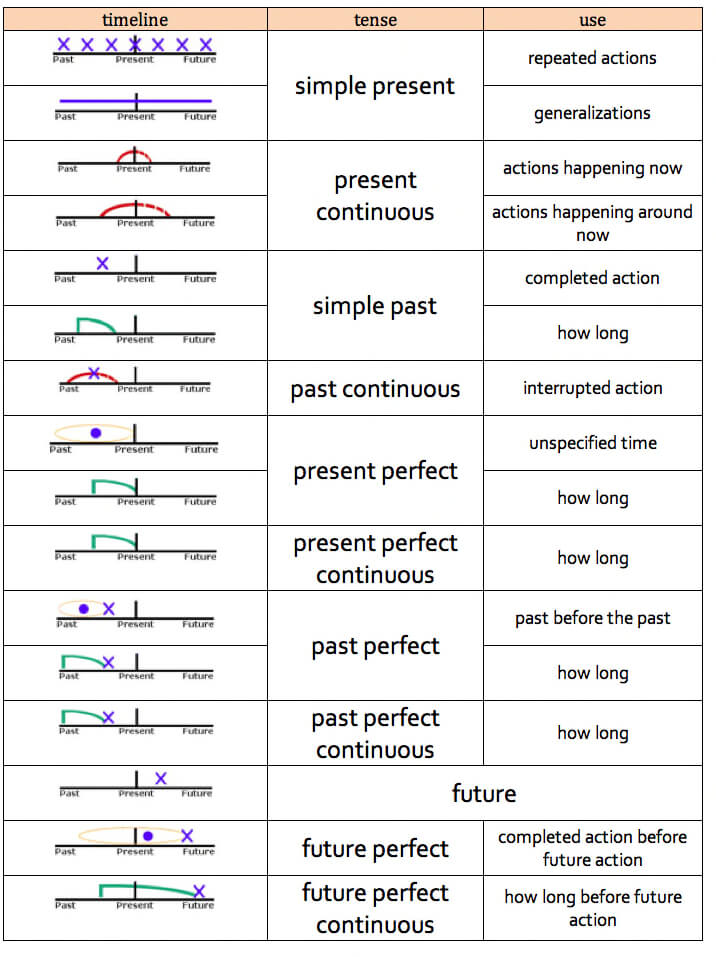
Here’s an overview of the most commonly used timelines, taken from englishpage.com, the best place for timelines (and verb tenses!) on the whole world wide web:
Thanks for reading. And, seriously, do give timelines a try.
I can’t find the verb tenses timeline chart on englishpages.com. Can you tell me where it is? It looks really useful and I’d like to get a copy.
Many thanks,
Nina
Hi, Nina
The chart I posted above is really a compilation of some of the most important timelines on englishpage.com. There, you’ll find one to three timelines per verb tense, rather than all of them together.
So maybe your best bet is to use this one.
I wondered if that’s what you’d done. it’s great, and thank you so much. Really useful.
Nina
🙂
I have been looking all over for a full chart. I had started compiling my own. Thanks.
Monique, glad it was helpful. Thanks for your comment.
oigf87 5e 8i7 ggder kyg
Simple to follow and very clear. Thank you so much for sharing.
Thank YOU, Barry.
Very very useful! Thanks for sharing. I will start using the chart tomorrow.
Great, Petra. Thanks!
I always use them to explain the difference bt past simple and past continuous. I’ll try the other ones. Thank you for sharing.
Thank you, Silvia!
Thank you for sharing this informative, clear chart. As a general rule, however, I tend to only teach verb tenses in particular contexts and my intermediate and even advanced students usually only use a handful of these tenses – like many native speakers. The present perfect is far more useful than some of the other tenses. I do wish, however, that this sort of clear chart were added as an appendix to almost all grammar books.
Hi, Eric. Thanks for stopping by.
You’re right – I would normally only tackle one or two tenses at any given time. This chart is meant more as a reference tool, rather than something for students to plod through in class.
Thank you very much for this useful chart. You’ve been mos generous in sharing it,
Although I agree that we generally teach one tense at a time, or maybe compare two or three, there comes a time when the student’s schemata gets all mixed up and a chart like this will shed some light and help making a mental image of the various tenses. Thanks again.
Thank you for stopping by, Graciela.
I do use timelines when teaching tenses and they are more then helpful, especially for Present Perfect ( students find it diffult to grasp).I don’t use the ones already made, I draw them myself, because I induce them to conclude the difference.
Thank you so much. This is excellent. I’m just about the embark on my TEFL training and am certain this will be very useful!
Thank you for stopping by, Amelia!
Nice post!
I’ve been encouraging students (usually low intermediate ones onwards)
to draw their own timelines – similar to the one they have on Facebook – on a sheet of paper eliciting the most relevant facts in their lives as means of introducing themselves . Later on they analize the sentences that they wrote and realize what verb tenses they used ou should have used to perform such task. By doing so they end up noticing that studying grammar topics may be entertaining too.
Congratulations on the blog, it has contributed a lot for my teaching!
Interesting idea to ask students to draw their own timelines, Rafael. Thanks for stopping by and thank you for your kind words.
It’s awesome! Thank you. 🙂
Thank you!
Hi, I wonder if you could help me. I have trouble understanding what the “x” represents in a timeline.
Lin, X = action.
When I initially commented I clicked the “Notify me when new comments are added” checkbox and now
each time a comment is added I get four emails with the same comment.
Is there any way you can remove people from that service?
Thanks a lot!
Ricardo, I will try to unsubscribe you, Ok?
Ricardo, I couldn’t find your initial post. Since you’re not a subscriber, all I can do is trash the original post. Do you remember where/when you commented?
whoah this weblog is magnificent i like reading your posts.
Stay up the great work! You realize, lots of people are
looking round for this information, you could help them greatly.
Proper drainage is an additional concern with old plumbing.
One is the fact that they spend a great deal of their time driving
in one house or flat to a different. Flanges produced of cast iron and cast brass avout
the other hand, are a llot more vulnerable to get rid of.
Hey! This is kind of off topic but I need some guidance from an established blog.
Is it difficult to set up your own blog? I’m not
very techincal but I can figure things out pretty quick.
I’m thinking about setting up my own but I’m not sure
where to begin. Do you have any points or suggestions?
Cheers
I really want to know the reasons why you titled this particular blog post,
“timelines”. In any event I personally
enjoyed the blog!Thank you,Christena
This is so useful as I am not a native english speaker and a writer. Thank you and keep up the good work! 😀
Thank YOU!
One more column giving a couple of examples of the actual verbs would make this chart invaluable.
It’s really useful post thanks
Thank you!
This is a great timeline chart thank you for making it!!!! In order to give a copy to a student can I just print it off and do © Luis Otavio? sorry but am new to this!!!!! many thanks
My students like it very much. Can I collect some more printable grammar charts from your blog spot?
Do you have tenses picture with example of sentence?
This is great help, Thanks
Hi! I love the chart of overview of most commonly used timelines, taken from englishpage.com. Am I allowed to copy it and make it into a poster?
Thanks Luiz for this chart! I am currently doing my CELTA as a top up qualification and this is absolutely invaluable for getting those simple timelines into my Lesson Plan documents efficiently. You are a gem!
Thank you!